
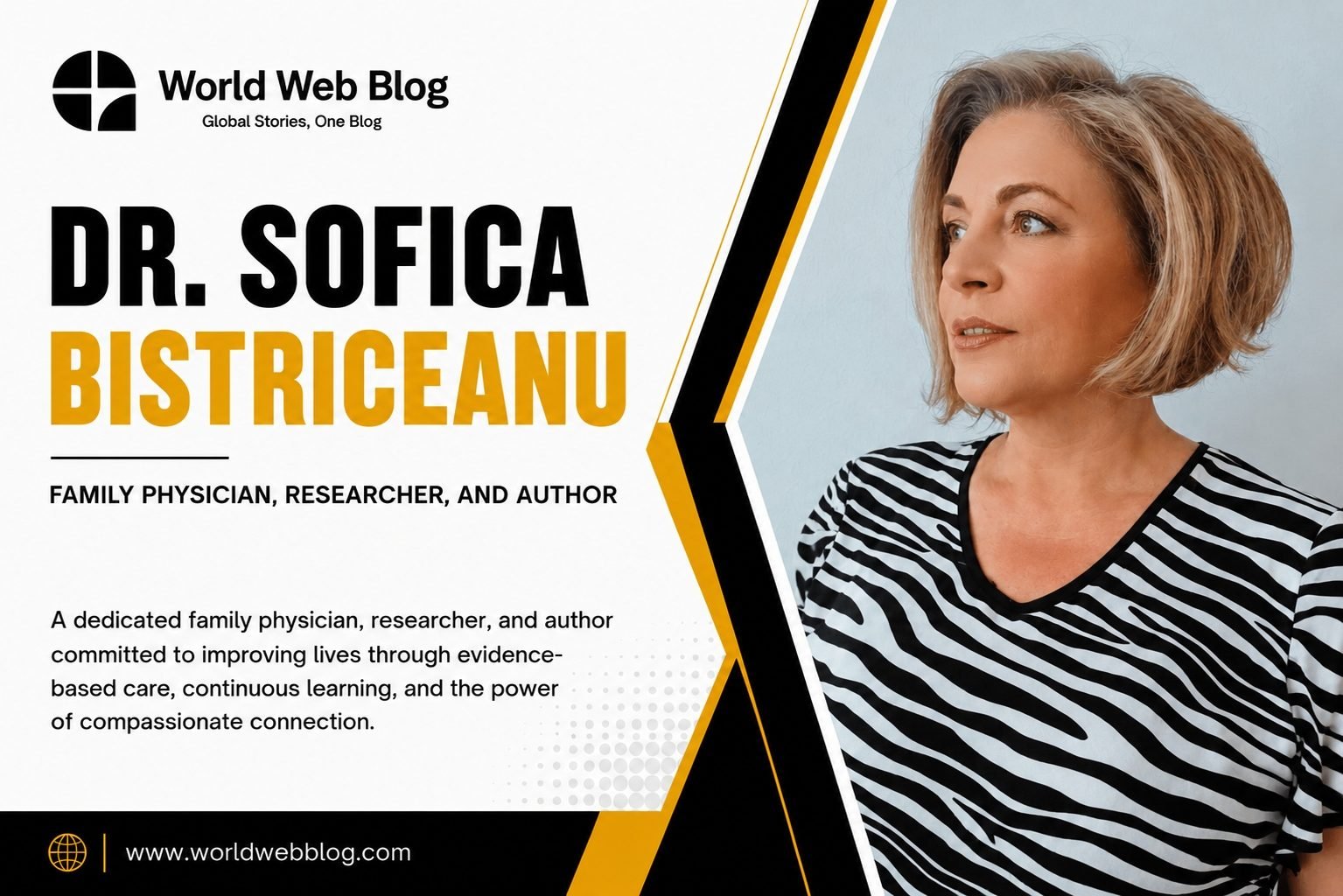
For Dr. Sofica Bistriceanu, medicine has never been limited to what happens inside a consultation room. A family physician, researcher, and author, her work has grown from clinical practice into home-based care, international research, academic contribution, and a broader interest in how communication, environment, and human relationships shape the experience of health. Since establishing her own family medicine practice in Romania in 1999, she has continued to look for ways of making care more accessible while paying closer attention to the person behind the medical problem.
Her journey has included the development of a medical home model, more than 150 international presentations, 67 published articles, professional and editorial roles, and seven published poetry volumes. In 2013, her practice was renamed the Academic Medical Unit – CMI Dr. Sofica Bistriceanu, S. Her work has continued to bring together clinical practice, research, technology, and human observation.
We spoke with Dr. Sofica Bistriceanu about the experiences that shaped her career, her approach to healthcare delivery, the observations that influenced her research, the role of technology in modern care, and the leadership principles that guide her work.
A Career Shaped by Family Medicine – Dr. Sofica Bistriceanu
We began by looking at the experiences that first shaped Dr. Sofica Bistriceanu’s approach to medicine, particularly her education and the decision to establish her own practice.
“Could you share a bit about your early background, education, and the key experiences that shaped your career journey?”
Reflecting on the beginning of her career, Dr. Sofica Bistriceanu explained how her education and early experience in family medicine led her toward a different approach to patient care.
“I graduated from Grigore T. Popa University of Medicine and Pharmacy, Iasi, Romania, and successfully completed, during the years 1998-2000, the training program in research at the Netherlands School of Primary Care Research. Currently, I have more than 150 international presentations and 67 articles published in top journals, and I have received many awards.
In 1999, when family medicine was introduced in Romania, I created my own practice, CMI Dr Bistriceanu S., with a patient list of 1,000 who preferred my services. In 2008, I shifted the delivery of medical services from office-based care to patients’ homes, especially for those with advanced heart disease, mobility issues, and children with acute medical conditions, creating the medical home model, a private practice.
By choosing well-prepared, respectful, and loyal collaborators, I have created a safe environment. Having access to more patient data, usually unavailable during an office visit, such as environmental characteristics, communication in the family and community, access to IT advancements, social networking, and so on, I better observed their influence on human balance. New insights that emerge in this context about the onset and progression of individual disorders, I shared with international medical communities for reflection.
In 2013, based on my achievements, my practice was renamed the Academic Medical Unit – CMI Dr. Sofica Bistriceanu.”
Moving Beyond the Traditional Medical Office
We then explored how the practice evolved after introducing a different way of delivering healthcare and what it takes for people to accept a new model.
“How has your company evolved since its inception?”
Dr. Bistriceanu reflected on the patience required when introducing a new approach to healthcare and the importance of proving its value over time.
“When a new health care delivery model is introduced, people usually adopt the ‘wait to see!’ approach. Acceptance of a new model requires time to validate its efficiency. Best clinical outcomes, interaction skills with patients and their loved ones, prices, generosity, and provider reputation in real and online communities predict a new business model’s trajectory: advance or decline.
Because adoption takes time, additional financial resources are required for career advancement. In this context, collaboration with other departments in the national health system and with private clinics is necessary.”
Creating a Different Healthcare Model
To understand the wider contribution of her work, we asked Dr. Bistriceanu how her practice has contributed to healthcare delivery in her region.
“How does your business contribute to the ecosystem in your region?”
She identified three areas that have been particularly important in her work: the way medical services are paid for, the way they are delivered, and the insights that have emerged through her clinical observations.
“New model of payment for medical services. New model of delivering medical services. New emergence of insights relating to disease onset and progression.”
She explained how the model combines different forms of access to care, including fee-for-service home visits and collaboration with medical centres operated by the national health system.
“Fee-for-service at home. Free medical services at Medical Centers operated by the national health system.”
The delivery model also expanded beyond face-to-face consultations.
“In-person: at home, in the office practice, at medical centers. E-visits, e-follow-ups, e-prescriptions, e-collaboration with other departments in the healthcare industry, including establishing an accurate diagnosis.”
For Dr. Bistriceanu, the medical home model also meant that patients could receive care at home while saving time and travel expenses. Through collaboration with the national health system, patients who could not afford fee-for-service home care could also benefit from free medical services in medical centres.
What Her Clinical Work Revealed
As her work increasingly took her into patients’ homes, we wanted to understand what she began observing beyond the immediate medical concerns presented during a consultation.
“What new insights emerged from your experience of visiting patients at home?”
Dr. Sofica Bistriceanu pointed to communication as one of the areas that particularly caught her attention.
“While visiting patients at home, I observed how varied communication styles affect human balance.”
This observation became part of her research. In 2016, at the American Academy of Communication in Healthcare Research Forum in New Haven, Connecticut, she presented a theory titled “The Effects of Inappropriate Words’ Energy Transfer to Vulnerable People and How to Balance Them.”
She described how her observations led her to consider the relationship between communication, personal feelings, and individual sensitivity.
“I have observed that people’s exchanges influence personal feelings positively or negatively, depending on the product’s quality and price, communication style, and individual sensitivity to potentially inappropriate communication.”
She also described observations regarding a lack of fresh air indoors, physical inactivity, relationship disappointment, and other circumstances that she believes may affect vulnerable individuals.
“Generosity toward those in need enhances personal feelings, improving one’s life and reputation in the time ahead.”
Bringing Technology Into Patient Care
We then turned to the role technology has played in the evolution of her healthcare model, particularly in maintaining communication and follow-up beyond physical consultations.
“How has your organization adapted to technological change? Share a key innovation you’ve implemented?”
Dr. Sofica Bistriceanu pointed to several digital services that have become part of her approach to healthcare.
“E-visits, e-prescriptions, e-follow-ups, and e-communication with other departments in the healthcare industry.”
She also encourages patients to participate actively in monitoring aspects of their health.
“Patients are invited to be active participants in managing their health: self-monitoring essential parameters of their functioning, such as blood pressure, heart rate, blood glucose levels, and oxygen saturation; adjusting medication dosage when required; and seeking expert advice from virtual assistants or real medical professionals.”
For her, technology also changes how people can manage their everyday interactions.
“People are invited to recognize the value of their interactions for personal health. In this era, they can avoid collaborating with dishonest, disrespectful people by blocking them. This allows offenders to reflect on what happened and try to correct themselves.”
The Qualities That Matter
With her experience across clinical care, research, and healthcare delivery, we asked Dr. Sofica Bistriceanu what she considers essential for anyone working in the field.
“What three qualities do you believe are critical for success in your industry?”
Her answer was concise.
“Integrity. Curiosity. Passion.”
These qualities also appear in the way she approaches leadership and teamwork. For Dr. Sofica Bistriceanu, creating the right working environment begins with the people chosen to be part of it.
Building a Safe and Supportive Workplace
We then asked about the lessons she would share with someone trying to establish their own services in healthcare.
“How would you guide someone to navigate the key challenges you faced when establishing your services in this industry?”
Dr. Sofica Bistriceanu emphasised independence, fairness, preparation, and the importance of treating people with respect.
“It is better to work independently and create a safe, friendly workplace. Select well-prepared, loyal, and kind collaborators. Be honest and fair in decision-making.”
She also believes leaders should be attentive to the details of their work, resolve workflow issues on time, support their teams during difficult periods, and remain open to suggestions.
“Consider minor errors as human; judge moderate, unintentional errors with heartfelt understanding, but never tolerate major, intentional errors, which will be judged with only a cool head.”
Recognition also matters to her approach to leadership.
“Recognize team members’ accomplishments and incentivize them.”
And alongside performance, she stresses the importance of protecting people from burnout.
“Take care to avoid burnout, since it undermines all you have worked hard to build.”
Looking at the Person Behind the Problem
Across her clinical practice, research, technology work, and writing, Dr. Bistriceanu’s career reflects a consistent interest in looking beyond the immediate medical issue.
Her move into home-based care allowed her to observe patients in their everyday environments. Those observations shaped questions that she later shared with international medical communities, while technology opened additional ways of delivering and following up on care.
Alongside medicine, her academic and creative work has continued to grow, with more than 150 international presentations, 67 published articles, numerous awards, professional and editorial roles, and seven poetry volumes.
At the centre of it all is an approach built around the qualities she identified herself: integrity, curiosity, and passion. For Dr. Sofica Bistriceanu, understanding healthcare means continuing to look, listen, question, and remain open to what the patient and the wider human context can reveal.
Connect with Dr. Sofica Bistriceanu on LinkedIn to learn more about her work in family medicine, healthcare research, communication, and her evolving approach to patient-centred care.
Read more:
Inaas Abdalla | Building Science-Backed Beauty Brands With Purpose and Integrity
Heartset Over Mindset: Nils Ehle on the Future of Work in an AI World